RR No. 6-2026 Explained: Mandatory CWT Line Items on Invoices and How to Automate Compliance in Juan

BIR Creditable Withholding Tax Rules on Invoices: Compliance Guide for Philippine Businesses
Navigating BIR RR No. 6-2026 under the EOPT Act: What business owners need to know about mandatory Creditable Withholding Tax (CWT) invoice disclosures, transitory rules, and 3-step compliance in Juan by JuanTax.
The Bureau of Internal Revenue (BIR) recently published Revenue Regulations (RR) No. 6-2026, amending Section 6(B) of RR No. 7-2024, under the Ease of Paying Taxes (EOPT) Act (RA 11976).
This update introduces a critical new mandatory display requirement to all invoices in the Philippines: Creditable Withholding Tax (CWT) must now be explicitly shown as a separate line item on the invoice itself whenever applicable.
Effective Date Notice: RR No. 6-2026 was signed by Finance Secretary Frederick D. Go on August 25, 2026, and officially published on the BIR Official Website on October 1, 2026. Pursuant to Section 6, the regulation takes effect fifteen (15) days following its publication in the Official Gazette or on the BIR Official Website, whichever comes first—making it effective on October 16, 2026.
This article provides you with a quick breakdown of what RR No. 6-2026 requires, the transition rules for existing printed invoices, and how you can seamlessly handle this within your Juan Accounting Software.
What Does RR No. 6-2026 Require?
Issued under Sections 244 and 245 of the Tax Code in relation to Section 47 of the Ease of Paying Taxes (EOPT) Act (RA 11976), Revenue Regulations No. 6-2026 adds item 22 to the list of mandatory information required on all invoices.
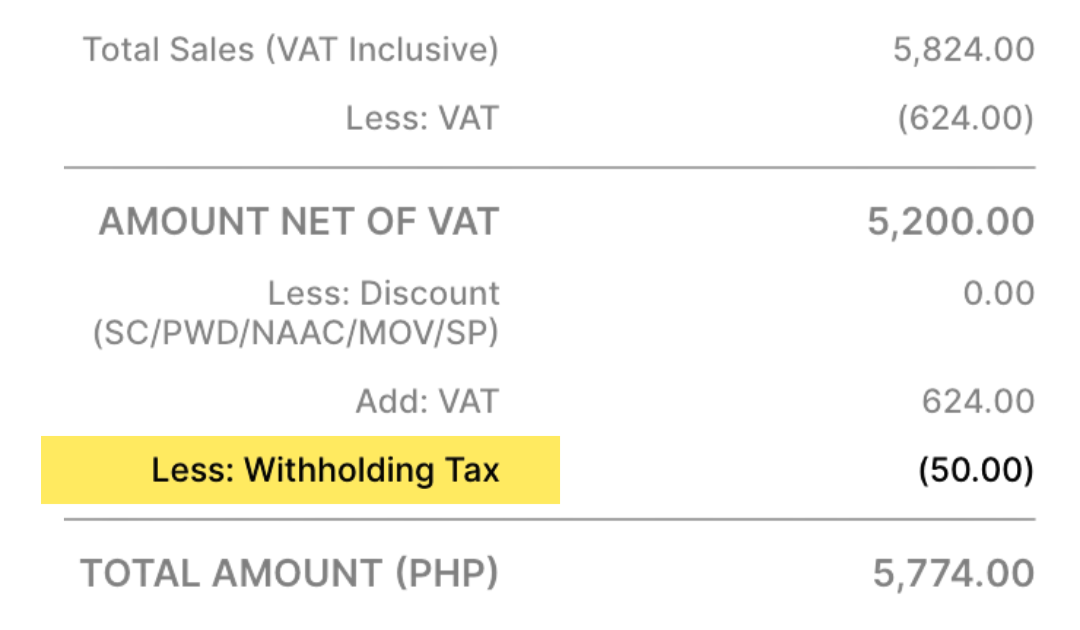
The core requirement of this regulation is straightforward: The amount of Creditable Withholding Tax (CWT), if applicable, must be shown as a separate line item on the face of the invoice.
Key Requirements and Operational Impacts:
Transitory Guidelines for Unused Manual Invoices
Section 3 of RR No. 6-2026 underscores the specific transitory provisions for taxpayers that still utilize physical, printed invoice booklets. The BIR allows businesses to consume their existing inventories without imposing an immediate reprint, provided specific marking rules are followed.
- Unused Stock Stamping: Businesses may continue to use existing unissued stock until fully consumed, provided that the phrase “Less: Withholding Tax” is conspicuously stamped on the face of every invoice issued.
- Newly Printed Invoices: All newly printed invoices must reflect the phrase “Less: Withholding Tax” before use.
How to Comply in Juan Accounting Software
If you use the Juan Accounting Software to generate invoices and manage your sales records, staying compliant with RR No. 6-2026 takes just three simple steps:
Step 1: Create or Select Your Invoice
Log in to your Juan account. Navigate to the Invoices module and click Create Invoice (or open an existing draft). Fill in the client and line-item details as usual.
Step 2: Apply Record Withholding
On the invoice entry screen, select Record Withholding before issuing the invoice. Choose the applicable Alphanumeric Tax Code (ATC) or the creditable withholding tax rate for your client. Juan automatically calculates the exact CWT amount based on the net sales (excluding Output VAT), keeping your VAT base accurate and intact.
Step 3: Print PDF/Issue E-Invoice
Click Print PDF or send the invoice to your customer electronically. The generated document will automatically display the “Less: Withholding Tax” line item right inside the summary box below your total sales breakdown.
Summary Checklist for Business Owners
- For Manual Invoices: Get a rubber stamp reading "Less: Withholding Tax" and stamp all unissued manual invoice booklets in your inventory.
- Digital Invoices in Juan: Use the Record Withholding feature on sales to clients who withhold taxes at source before finalizing the invoice.
- Quarter-End Reconciliation: Compare the CWT disclosed on your invoice with the amount actually withheld by your client and the BIR Form 2307 issued for the transaction. If your client does not withhold or the actual amount differs from the amount shown on the invoice, review the payment records and applicable withholding tax documentation to reconcile the difference. Form 2307 serves as documentation of the tax actually withheld; the invoice disclosure doesn't replace it.
- New Print Runs: Ensure your printing partner includes the pre-printed "Less: Withholding Tax" line on all newly printed invoice booklets.
Frequently Asked Questions (FAQ)
1. Does displaying CWT on the invoice replace BIR Form 2307?
No, since BIR Form 2307 (Certificate of Creditable Tax Withheld at Source) is still legally required. The invoice disclosure provides transparent proof of expected tax deductions, however the buyer must still issue Form 2307 as legal proof that the tax was withheld and remitted to the BIR.
2. What if my client withholds a different amount than estimated on the invoice?
The CWT disclosed on an invoice may differ from the amount ultimately withheld when payment is made. If your client does not withhold or withholds a different amount, review the transaction, payment records, and applicable withholding tax rules. Reconcile the difference against the BIR Form 2307 issued by your client, where applicable. The invoice disclosure alone does not establish that CWT was actually withheld.
3. Does RR No. 6-2026 change Value-Added Tax (VAT) computations?
No, since the Creditable Withholding Tax (CWT) is an advance payment of Income Tax, not Value-Added Tax. CWT deductions do not alter your gross Output VAT base.
4. Does this rule apply to electronic invoices (e-invoices)?
Yes, since all billing documents, such as manual booklets, computer-generated invoices, or electronic invoicing systems (EIS), must comply with mandatory disclosure requirements.
Stay Ahead of BIR Mandates with Juan
Stay ahead of BIR mandates without the stress. From automated CWT disclosure to full e-invoicing readiness, Juan by JuanTax keeps your accounting compliant so you can focus on growing your business. Book a call today to get started on streamlining your invoicing workflows.
Last updated: October 14, 2026. This article reflects our understanding of BIR Revenue Regulations No. 6-2026 as of the publication date. Always consult with your CPA or tax advisor for specific guidance on your compliance obligations.